|
Getting your Trinity Audio player ready...
|
Eight real causes — from low refrigerant to undersized systems — explained by a UAE HVAC team that has been solving exactly this problem for over 30 years.
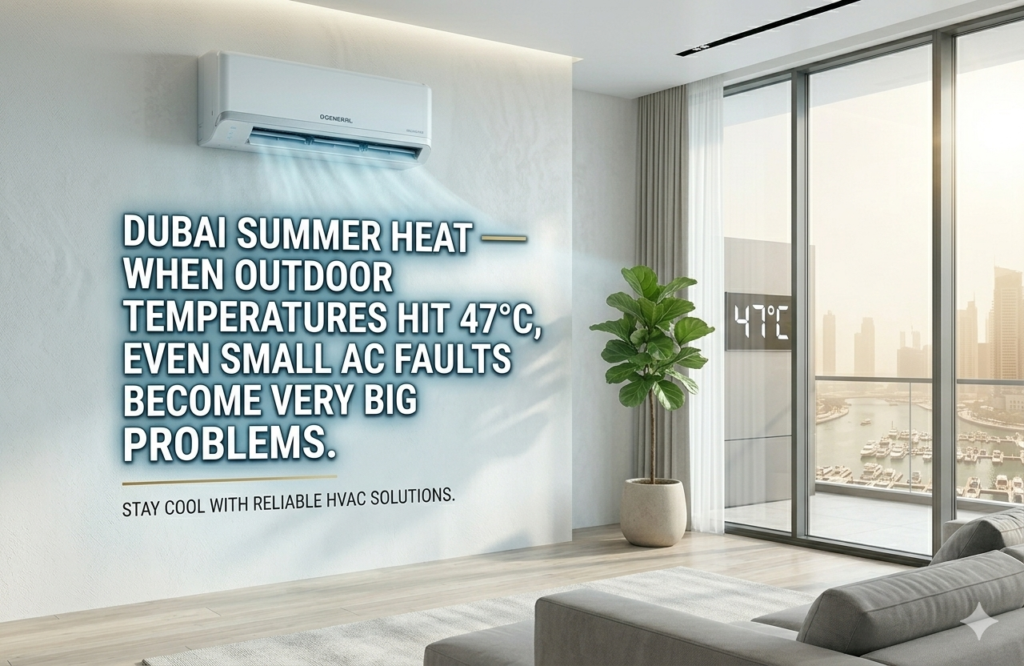
It’s the middle of July. Outside, it’s 47°C. You walk into your villa, expecting that familiar wave of cool air, and instead — nothing. Warm, still air. Your AC is running, you can hear it, but the room temperature is barely dropping. Maybe it’s cooler than outside, but it certainly isn’t the 21°C you set on the thermostat.
This is one of the most common complaints we get at Khalifa Air Conditioning during the UAE summer months. And it’s more than just uncomfortable — in a country where the heat can be genuinely dangerous, an underperforming AC system is a real problem that needs real answers.
After more than 30 years of servicing, installing, and contracting AC systems across Ajman, Dubai, and the wider UAE, we’ve seen this situation countless times. The good news is that most causes are diagnosable, and many are preventable. In this article, we’ll walk you through exactly why this happens, what the warning signs are, and what you should do about it.
“In 30 years of working on AC systems in the UAE, we’ve learned one thing for certain: an AC that’s struggling in July has almost always been showing small warning signs since March. The summer heat doesn’t break your system — it reveals the problem that was already there.”
Dubai Summer Does Not Forgive a Struggling AC System
Why UAE Conditions Are Uniquely Demanding on AC Systems
To understand why AC systems fail so often during UAE summers, you first need to understand what we’re actually asking these machines to do. In most countries around the world, an air conditioning system runs for a few months a year, perhaps six to eight hours a day. Here in the UAE, that calculation is completely different.
From roughly April through October — that’s seven months — most AC systems in Dubai, Ajman, and Sharjah run continuously. Not a few hours. Continuously. In a villa, your AC may be running 20 to 22 hours a day during peak summer. Outdoor temperatures regularly exceed 45°C and can touch 50°C in exposed areas. The humidity in coastal areas like Dubai adds another layer of strain that doesn’t show up in the temperature reading but absolutely shows up in your system’s workload.
What this means practically is that the same components that might last 15 years under normal use are being compressed into far fewer effective years. Filters that might need cleaning monthly in a moderate climate need cleaning every three to four weeks here. Refrigerant that develops micro-leaks slowly in other countries depletes faster under sustained high-pressure operation. And dust — the fine, pervasive sand dust of the Gulf — gets into everything.
So when people ask us why their AC is not cooling in Dubai, the honest answer is: because you’re asking your system to do something that no other climate demands, often without the maintenance that this level of use requires.
The 8 Most Common Reasons Your AC Is Not Cooling Properly
Let’s get into the specifics. These are the causes we actually encounter, in roughly the order of how commonly we see them during summer callouts across our service areas.
01 Low or Depleted Refrigerant
Refrigerant is the substance that actually makes cooling happen. It circulates between your indoor and outdoor units, absorbing heat from inside your home and releasing it outside. When refrigerant levels drop — which happens slowly from micro-leaks in the system — your AC’s ability to cool drops with it. In mild cases, you’ll notice the room taking longer to reach the set temperature. In severe cases, the system runs non-stop without ever achieving the temperature you’ve selected.
What makes this particularly dangerous in UAE conditions is what happens to the compressor when refrigerant is low. The compressor has to work harder to circulate less refrigerant, generating excess heat in the process. Over time, this causes the compressor to overheat and eventually fail. Compressor replacement in the UAE can cost anywhere from AED 2,000 to AED 6,000 or more — a cost that a simple refrigerant top-up would have prevented.
Important: Refrigerant doesn’t just “run out” naturally. If your levels are low, there is a leak somewhere that needs to be found and fixed. Simply topping up the refrigerant without addressing the leak is a temporary fix that will repeat itself.
CRITICAL ISSUE
02 Dirty or Blocked Air Filters
This is the most common cause we find — and the most preventable. Air filters are your system’s first line of defence against dust, and in the UAE, they face a level of dust that most manufacturers’ maintenance schedules simply weren’t designed for.
When filters become clogged, airflow through the system is restricted. Less air passes over the evaporator coil, which means less cooling happens. The system works harder to push air through the blockage, consuming more electricity while delivering less cooling. In some cases, severely blocked filters can cause the evaporator coil to ice over — the opposite of what you need in 45-degree heat.
We typically find that villa owners in Dubai and Ajman who are cleaning their filters once every two or three months are significantly under-maintaining for UAE conditions. During summer, monthly cleaning is the minimum. If your property is near construction sites or sandy areas, every three weeks is better.
VERY COMMON
03 Dirty Evaporator or Condenser Coils
Even with clean filters, dust eventually makes its way onto the coils — the components where the actual heat exchange happens. The evaporator coil (inside your property) and the condenser coil (in the outdoor unit) both need to be clean and clear to transfer heat efficiently.
In outdoor UAE conditions, the condenser coil is particularly vulnerable. It sits exposed to whatever is in the air — dust, sand, and in some areas, fine salt particles from coastal environments. A condenser coil coated with even a thin layer of dust and debris can lose 20 to 30 percent of its heat rejection efficiency. Your AC is literally trying to push heat outside through a partially blocked barrier.
Coil cleaning is something that must be done by a professional with the right equipment. It’s part of what our AC maintenance services include on every service visit.
COMMON
04 The System Is Undersized for the Space
Sometimes the AC isn’t failing — it was never adequate in the first place. This often happens when extra rooms are added, when internal layouts change, or simply when the original system was specified by someone who didn’t properly calculate the cooling load for UAE climate conditions.
An undersized system will run continuously without ever reaching the set temperature during peak summer. This creates a cycle of wear — the system never gets a rest, components overheat, and lifespan is dramatically reduced. The only real fix here is upgrading to correctly sized equipment.
This is one of the reasons why proper system sizing by an experienced AC installation matters so much at the outset. Getting it right initially prevents years of underperformance and early component failures.
DESIGN ISSUE
05 Blocked or Leaking Ducts (Ducted Systems)
If you have a ducted AC system in your villa — and many larger properties in Dubai and Ajman do — duct problems can significantly reduce cooling performance even when the central unit itself is working perfectly. Over time, ducts can develop leaks at connections, or accumulate enough dust and debris internally to restrict airflow to certain zones of the property.
A common pattern we see with AC installation properties is that the master bedroom or majlis stays cool while remote rooms — a far bedroom, a storage room with a ceiling vent — barely cool at all. This often indicates a duct connectivity issue, a blocked duct run, or insufficient duct sizing for those zones.
Regular duct inspection is part of what differentiates a thorough maintenance service from a basic one. We check duct integrity, connection seals, and airflow to all terminal points as part of our ducted system maintenance visits.
COMMON IN VILLAS
06 Electrical Faults — Capacitors and Contactors
The electrical components of an AC system — particularly the start capacitor and run capacitor on the compressor and fan motors — are wear items that degrade over time. In UAE conditions, where the system runs continuously at high loads for months, these components fail faster than standard schedules predict.
A failing capacitor usually causes the compressor or fan motor to struggle to start, or to run at reduced efficiency. You might notice the outdoor unit making a humming sound, or the compressor stopping and restarting frequently. Left unaddressed, a failed capacitor puts excess stress on the motor itself, which can then burn out — a much more expensive repair.
Checking capacitors and contactors is part of any proper electrical inspection during a service visit. It’s inexpensive to replace these components proactively, and significant in what it prevents.
CRITICAL WHEN IGNORED
07 The Thermostat Is Faulty or Incorrectly Set
Before calling for a technical visit, it’s always worth checking the obvious. A faulty thermostat, a temperature sensor that has drifted out of calibration, or simply incorrect settings on newer digital or smart thermostats can all cause your AC to behave as though it’s not cooling — even when the mechanical system is fine.
We’ve attended callouts where the “AC not cooling” problem turned out to be a thermostat in “fan only” mode, or a sensor reading several degrees higher than the actual room temperature, causing the system to think the room was already at target temperature. These are quick fixes, but they’re worth checking before assuming the worst.
CHECK FIRST
08 Outdoor Unit Is Obstructed or Exposed to Direct Sun
The outdoor condenser unit needs clear airflow around it to reject heat effectively. A unit that is surrounded by walls on three sides, placed in a tight mechanical room with poor ventilation, or sitting in direct afternoon sun for most of the day will struggle to reject the heat it needs to.
We frequently see outdoor units in Dubai and Ajman villas that were placed in corner locations during original construction without proper consideration of airflow. In UAE summer conditions, a poorly positioned outdoor unit can lose 15 to 25 percent of its cooling efficiency simply because it can’t shed heat fast enough.
In some cases this requires physical relocation of the outdoor unit — which we handle as part of our AC Ac contracting services — and in others, adding shading or improving the surrounding ventilation can make a meaningful difference.
INSTALLATION FACTOR
Warning Signs You Must Never Ignore
Some of the causes above build up gradually. Your AC doesn’t go from perfect to broken overnight — it usually tells you something is wrong weeks or months before it fails completely. Here are the warning signs that should prompt you to call for a service visit, rather than waiting until the system gives out entirely.
Signs That Need Immediate Attention
🌡️ Room takes more than 30–40 minutes to cool
Normal cooling time for a properly sized and maintained system should be noticeably faster. Prolonged cooling usually means low refrigerant or restricted airflow.
ACT NOW
💧Water dripping from the indoor unit
Blocked drainage or a frozen evaporator coil. Can cause significant water damage to ceilings and walls if not addressed quickly.
ACT NOW
🔊Unusual sounds — grinding, rattling, or buzzing
Grinding often means a motor bearing failing. Rattling can be loose components. Buzzing at the outdoor unit may indicate electrical issues or a struggling compressor.
ACT NOW
Signs That Need Attention Within a Week
💨 Weak airflow from vents
May indicate severely blocked filters, duct obstruction, or a failing fan motor. Reduces cooling efficiency significantly and adds strain to the system.
WITHIN A WEEK
⚡ Noticeably higher electricity bills
An AC working harder to achieve the same result will consume more electricity. A sudden spike in your DEWA bill during consistent usage is often an early AC health indicator.
WITHIN A WEEK
🌀AC keeps turning on and off frequently
Short cycling — where the system starts, runs briefly, and shuts off — can indicate low refrigerant, an oversized system, or thermostat issues. Puts excessive wear on the compressor.
WITHIN A WEEK
🤧 Musty or unusual smell from vents
Can indicate mould growth inside ducts or the indoor unit, or a drainage issue. Air quality concern especially for families with young children or respiratory conditions.
SCHEDULE SOON
⚠️ Do not ignore water dripping from your AC indoor unit. Even a small, slow drip can cause major water damage to plasterboard ceilings, wooden flooring, and electrical fittings over a surprisingly short time. In the UAE’s construction style, ceiling water damage is expensive to repair and often not visible until it’s significant. This is one we always treat as urgent.
Why Regular Maintenance Changes Everything in UAE
What a Proper UAE Maintenance Visit Should Cover
Every single one of the eight causes we listed above — bar a genuine manufacturing defect or severe physical damage — is either directly preventable or significantly slowed by regular professional maintenance. This is not a sales pitch. It’s just the reality of how these systems work.
When our engineers visit a property on an emergency callout in July, we almost always find one of two situations: either the property has had no maintenance in over a year, or they had “maintenance” done by someone who cleaned the filters and nothing else. Real AC maintenance services go significantly deeper than that.
A proper UAE maintenance visit should cover, as a minimum:
- Complete indoor unit cleaning — not just filter removal, but coil surface cleaning and drainage pan inspection
- Outdoor condenser coil cleaning with appropriate tools and cleaning agents
- Refrigerant pressure check using gauges — not just a visual inspection
- Electrical inspection — capacitor testing, contactor condition, wiring integrity
- Drainage line flushing and clearing
- Airflow measurement at the supply vents to detect duct issues
- Thermostat calibration check
- Full operating temperature check after service completion
Why an AC Maintenance Contract Makes Sense in UAE
This level of service, done twice a year in the UAE — once before summer and once after — keeps systems running efficiently, catches problems before they become expensive failures, and typically extends the operational life of your AC system by several years.
For property owners and landlords managing multiple units or commercial properties, an AC maintenance contract makes this straightforward. Rather than remembering to book visits and coordinating individually each time, a scheduled contract means your properties are looked after automatically, with priority response if anything arises between visits. We have commercial and residential contract customers across Ajman, Dubai, and Sharjah who have been on contract with us for over a decade — and that consistency is what keeps their systems reliable year after year.
Related Reading on Our Website
AC Maintenance Services — What We Cover and How Often You Should Service in UAE
AC Maintenance Contract — What’s Included and Is It Worth It?
AC Installation in UAE — How Getting It Right From the Start Prevents Future Problems
AC Installation for Villas in Ajman — Our Specialty
Contact Us — Free Site Inspection Across UAE
When to Stop Troubleshooting and Just Call a Professional
What You Can Check Yourself First
There are a handful of things a homeowner can check themselves before calling for a service visit: making sure the thermostat is correctly set, checking that the circuit breaker hasn’t tripped, cleaning or replacing the air filter if it’s accessible, and ensuring the outdoor unit isn’t visibly blocked by debris or overgrowth. These take five minutes and occasionally solve the problem.
Beyond that — particularly anything involving refrigerant, electrical components, coil cleaning, or duct inspection — you need a professional. Not because of any unnecessary gatekeeping, but because doing these things incorrectly creates more problems than it solves. Refrigerant handling in particular requires licensed equipment and training. An improperly topped-up system can cause compressor damage that costs many times the price of a proper professional visit.
As an AC contractor in UAE with over 30 years of field experience, we’ve seen the results of DIY refrigerant top-ups, improvised electrical repairs, and well-intentioned coil “cleaning” with pressure washers. In almost every case, the repair cost was significantly higher than it would have been if a professional had been called at the first sign of a problem.
When You Must Call a Professional Immediately
Call a professional immediately if you observe any of the following:
- Water dripping from the indoor unit — regardless of how minor it seems
- A burning or electrical smell from any part of the system
- The outdoor unit making loud, unusual mechanical sounds
- The circuit breaker tripping repeatedly when the AC is switched on
- Ice forming on any part of the indoor unit or refrigerant lines
- The system completely failing to start despite power being confirmed
Preventive Steps That Actually Make a Difference
Prevention in UAE conditions requires thinking slightly differently than the standard advice you’d find in a general AC maintenance guide. The climate here is specific, and the maintenance needs follow from that. Here are the steps that genuinely make a measurable difference:
Your UAE AC Maintenance Checklist
✓ Clean your filters every 3–4 weeks during summer (April–October). Not monthly, not quarterly — every three to four weeks. In dusty areas near construction or desert exposure, every two to three weeks.
✓ Book a pre-summer professional service in March or April. Before the peak heat arrives, have your system professionally serviced — coils cleaned, refrigerant checked, electrical inspection done. Starting summer with a clean, properly charged system makes an enormous difference.
✓ Check your outdoor unit monthly. Clear any debris, leaves, or sand accumulation from around the unit. Ensure there is at least 50cm of clear space on all sides for proper airflow. Check that the fins aren’t visibly clogged with dust.
✓ Keep the set temperature realistic for UAE climate. Setting your thermostat to 18°C when it’s 47°C outside forces the system to run at maximum capacity continuously. 22–24°C is both comfortable and sustainable. Every degree lower increases energy consumption by 6–8%.
✓ Close blinds and curtains during peak afternoon sun hours. Solar heat gain through glass is significant in UAE homes. Reducing it means your AC has less work to do and performs better. This is especially important for west-facing rooms in the afternoon.
✓ Book a post-summer service in October or November. After the intense operating months, your system needs to be checked for any wear, refrigerant changes, or component stress that accumulated over summer.
✓ Consider an annual AC maintenance contract. If you own a villa with multiple units, or a commercial property, a maintenance contract removes the need to track all of this yourself. Scheduled visits happen automatically, and you have priority access to our team if anything arises between visits.
💡 One thing that often surprises villa owners: the rooms that are least used are frequently the ones that cause the most problems. A guest bedroom or study where the AC runs without regular checks can develop drainage blockages, coil buildup, or refrigerant issues that go unnoticed until they affect the rest of the system. Include all rooms in your maintenance checks, not just the ones you use daily.
Is Your Ac Struggling This Summer?
Don’t wait for a complete breakdown in July. Our team covers Ajman, Dubai, Sharjah, Ras Al Khaimah, and Umm Al Quwain. A free site inspection costs you nothing — and could save you thousands in repair costs.
Frequently Asked Questions
Why is my AC running but not cooling in Dubai?
The most common reasons are low refrigerant levels, dirty coils, blocked airflow from clogged filters, an undersized system for the space, or electrical faults such as a failing capacitor. In Dubai’s summer heat — where outdoor temperatures regularly exceed 45°C — even a minor efficiency loss becomes very noticeable. A professional inspection will identify the exact cause and give you an honest assessment of what’s needed. Don’t put this off: a system running continuously in hot weather with an underlying fault will fail faster and more expensively than one caught early.
How often should I service my AC in the UAE?
At minimum, twice a year — once before summer in March or April, and once after the peak season in October or November. Filter cleaning should happen every three to four weeks during the summer months, given the UAE’s dust levels. For commercial properties, showrooms, or warehouses where systems run all day, quarterly professional servicing is recommended. An annual AC maintenance contract handles all of this automatically so you don’t have to track it yourself.
Can low refrigerant damage my AC compressor?
Yes, significantly. Running an AC system on low refrigerant forces the compressor to work much harder than it was designed to. This generates excess heat within the compressor itself, leading to overheating, lubrication breakdown, and eventually mechanical failure. Compressor replacement in the UAE typically costs between AED 2,000 and AED 6,000 or more depending on the unit. A refrigerant check and top-up costs a fraction of that. More importantly, if your refrigerant is low, there is a leak somewhere that needs to be identified and repaired — not just topped up.
Is it normal for AC to struggle when temperature exceeds 45°C in UAE?
A correctly sized and well-maintained AC system should handle UAE summer temperatures, including days above 45°C. It may not cool as quickly on extreme days, and it will run longer to maintain the set temperature — that’s normal. But if your system consistently fails to reach the set temperature even on moderately hot days, or if it runs continuously without achieving the target, something is wrong. Either the system is undersized for the space, the refrigerant is low, or a maintenance issue needs addressing. Don’t accept poor performance as normal UAE summer behaviour.
How much does an AC maintenance contract cost in UAE?
AC maintenance contract pricing varies depending on the number of units in your property, the type of property (villa, apartment, commercial), and the number of scheduled visits per year. Khalifa Air Conditioning offers competitive contract rates for both residential and commercial properties across Ajman, Dubai, Sharjah, Ras Al Khaimah, and Umm Al Quwain. We always recommend starting with a free site inspection so we can give you an accurate quotation based on exactly what your property needs — not a generic package that may not fit your situation. Contact us to arrange one.
My villa has a ducted AC system-can you service that too?
Absolutely. Ducted AC systems are something we have extensive experience with. We handle full ducted system maintenance — including duct inspection, airflow testing to all terminals, central unit servicing, and coil cleaning — for villas across our UAE service areas. We also handle duct AC installation in Dubai and Ajman for new villa projects and replacements. If you’re experiencing uneven cooling across different rooms in your ducted villa, that’s a very specific symptom that’s worth having properly diagnosed rather than guessed at.
The Bottom Line
What This Means for Your AC This Summer
If your AC is not cooling properly this Dubai summer, the problem is almost certainly one of the eight causes we’ve outlined above. None of them are mysteries. All of them are diagnosable by an experienced technician with the right equipment. And most of them — had they been caught during a routine maintenance visit in April — would have cost significantly less to address than they will in July.
The UAE climate is unforgiving to AC systems that aren’t properly maintained. But it’s entirely manageable if you approach it correctly. Clean filters, regular professional service, proper refrigerant management, and an honest relationship with a reliable AC contractor who knows what they’re doing — that’s genuinely all it takes to keep most systems running well for 15 to 20 years.
At Khalifa Air Conditioning, we’ve been helping families and businesses across Ajman, Dubai, Sharjah, and the wider UAE do exactly this for over three decades. We’re a family business — our name is on every job we do, and that keeps us honest. If your system is giving you trouble this summer, or if you’d like to talk about a maintenance contract to protect it going forward, we’d welcome the conversation.
No pressure. No inflated quotes. Just honest advice from a team that has been working in UAE HVAC since the early 1990s.
Khalifa Air Conditioning — Ajman, UAE
Free site inspection for new customers across all UAE service areas. Call us, WhatsApp us, or send us your details and we’ll come to you. Ajman · Dubai · Sharjah · Ras Al Khaimah · Umm Al Quwain.
Khalifa Air Conditioning
FAMILY-OWNED HVAC · AJMAN, UAE · EST. 1990+
Written by the Khalifa Air Conditioning team based on 30+ years of hands-on HVAC experience across the UAE. We’ve installed, maintained, and repaired thousands of AC systems in Dubai, Ajman, Sharjah, and beyond. Every piece of advice in this article is based on what we actually see in the field — not generic industry guidance.